
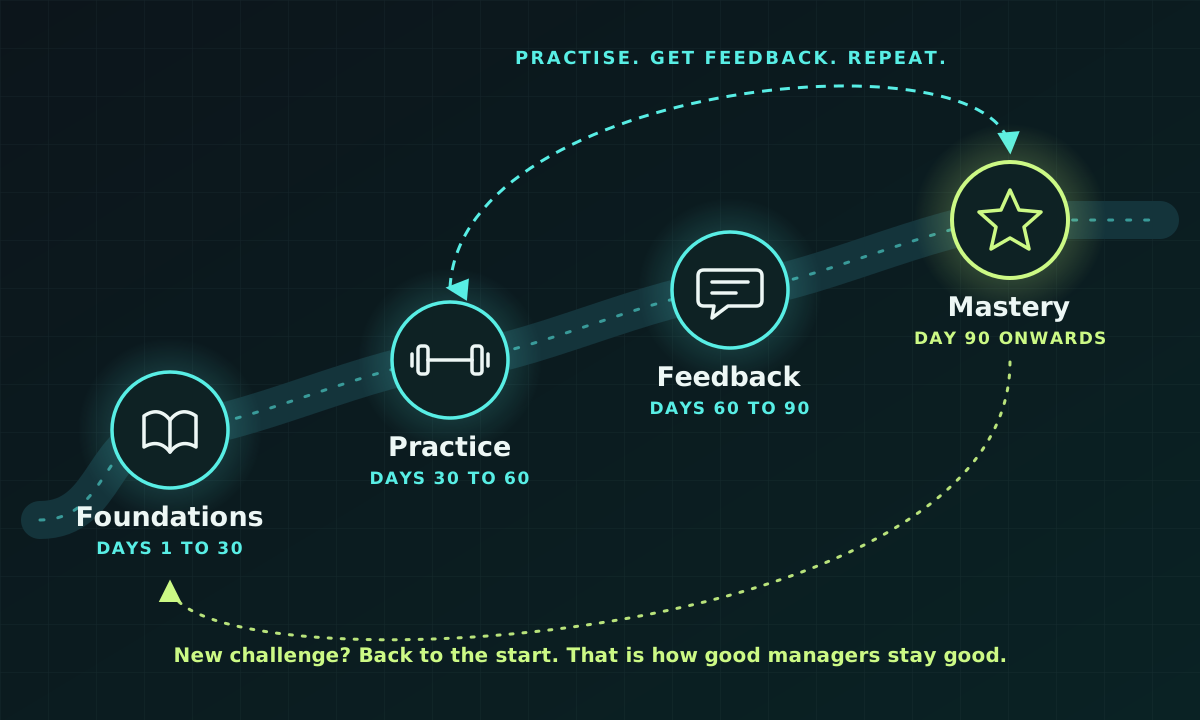
You’ve been promoted. Congratulations. Now comes the awkward bit: yesterday you were good at the work, and today you’re responsible for other people doing it.
Most new managers respond by doing more. More answers, more decisions, more visible activity. It feels like leadership. Usually it’s anxiety wearing a lanyard.
The first thirty days aren’t about proving yourself. They’re about laying foundations, and foundations are mostly invisible.
Listen before you act
Your team already has a view of how things work, what’s broken and who really makes things happen. You can’t see it yet, and they won’t volunteer it until they trust you.
So start with questions, and then stay quiet long enough to hear the answers. What’s working well? What frustrates you? What would you change if it were up to you? What should I never do?
Resist the urge to fix things as you hear them. If you jump to solutions, people learn that sharing a problem means losing control of it. If you listen without judgement, they learn that it’s safe to tell you the truth. That safety is the most valuable thing you will build in these thirty days.
Learn how the work really happens
The org chart tells you who reports to whom. It doesn’t tell you where work gets stuck, who people actually go to for help, or which meeting everyone dreads.
Spend time with the work itself. Sit in on stand-ups, read recent incident notes, watch a release or a hand-off. Ask people to walk you through a recent piece of work from start to finish. You are looking for friction, not faults.
You will also discover what you don’t know. Say so. A manager who says “I don’t understand that yet, can you show me?” earns far more respect than one who nods and bluffs.
Agree what success looks like, with your manager and with your team
This is the step most new managers skip, and it hurts them later. Within your first few weeks, have an explicit conversation with the person you report to. What does good look like at 30, 60 and 90 days? Which problems are yours to solve, and which are not? How often do you want to talk, and about what?
Then turn it around. Ask each person you lead, individually, what they need from you. How do they like to receive feedback? How much direction do they want, and how much space? What does a good week look like for them? What would make you easier to work with? The answers will differ from person to person, and that is exactly the point.
Expectations that stay unspoken become disappointments, in both directions. Ask early, write the answers down, and revisit them.
Make one-to-ones the backbone
If you do one thing in your first month, make it a regular, protected one-to-one with each person in your team. Keep them. Don’t cancel them when you’re busy, because that’s exactly when they matter.
Keep them about the person, not just the task. Let them set the agenda. Ask what support they need and what’s getting in their way. Then follow through on the small things you promise, because trust is built far more by kept small promises than by big speeches.
For the new manager
- Book a one-to-one with every direct report in your first week.
- Ask the same three questions of everyone, and write down the patterns.
- Agree 30, 60 and 90 day expectations with your own manager, in writing.
- Ask each person you lead what they need from you, one to one, and write it down.
- Choose one thing to observe rather than change.
For the sponsor or senior manager
- Don’t assume the promoted person knows how to start. Give them a real handover, not just a title.
- Make time for that expectations conversation, and have it early.
- Resist handing them a fire to put out in week one. Protect some space to listen.
- Tell them plainly that learning before acting is what you want, not slowness.
Foundations aren’t one-off
A word of reassurance. Foundations aren’t something you build once and forget. Whenever you face a new team, a new challenge or a change in your role, you’ll find yourself back here, listening, learning and agreeing expectations. That’s not failure. It’s how experienced managers stay good.
Next time, in Part 2, we move into Practice: small, safe experiments with delegation, one-to-ones and difficult conversations, and how to get them slightly wrong without losing anyone’s trust.